Inventory costing · Cost variance experts

Manufacturing Accounting Services That Reveal True Product Costs

Raw materials, WIP, finished goods - inventory-heavy accounting needs specialized expertise. Our manufacturing accountants deliver precise COGS calculations, cost variance analysis, and inventory valuations so you know the true cost of every product you make.
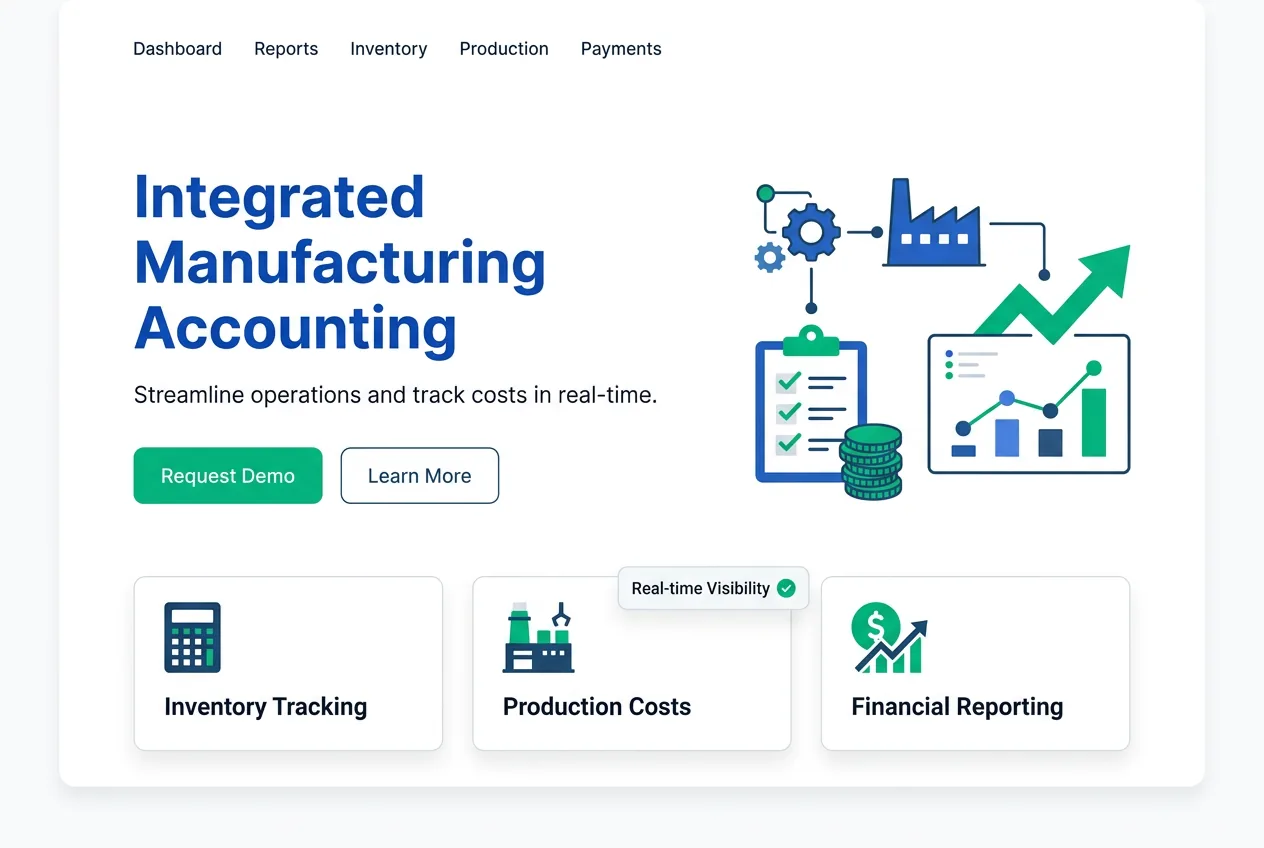

Manufacturing cost accounting dashboard showing COGS breakdown, inventory valuation, and production cost variance analysis
500+
Teams Deployed
99.5%
Accuracy SLA
70%
Avg Cost Savings
7-Day
Team Deployment
4.9 out of 5·from 120+ verified reviews
Clutch (4.9)Google (4.8)GoodFirms (5)

Accounting built for the factory floor, not the corner office

Manufacturing accounting is a specialized discipline that tracks the flow of costs through your production process - from raw materials purchased to work-in-progress to finished goods shipped. Unlike retail or service businesses, manufacturers must calculate cost of goods sold using complex methods that account for direct materials, direct labor, and manufacturing overhead. Standard costing, actual costing, FIFO, LIFO, and weighted average methods each produce different results and have different tax implications. Our manufacturing accounting team has supported manufacturers across automotive parts, food and beverage, electronics, building materials, and custom fabrication. We handle inventory valuation, COGS calculation, WIP reporting, cost variance analysis, and the financial reporting your management team needs to make informed pricing, production, and procurement decisions.

The accounting outsourcing market

More businesses are outsourcing accounting functions to reduce costs and improve accuracy.

$245B+
India IT-BPM industry revenue
NASSCOM, 2024
56%
Global outsourcing market share held by India
Deloitte, 2023
400K+
Chartered Accountants in India
ICAI, 2024

In-house cost accountant vs. Acelerar

In-House (US)

$65K/yr

per year / per person

Salary, benefits, ERP software licenses, and management overhead for one US-based cost accountant with manufacturing industry experience

With Acelerar

$19K/yr

per year / per person

Fully loaded rate includes salary, manufacturing-experienced accountants, inventory costing, COGS tracking, variance analysis, and dedicated account manager

What changes when you see your true production costs

Precise COGS Calculations

Every component of cost of goods sold - raw materials, direct labor, and manufacturing overhead - is tracked and allocated accurately. No more guessing at product margins or discovering cost overruns after the fact.

Real-Time Inventory Valuation

Raw materials, WIP, and finished goods inventory are valued in real time using your chosen costing method (standard, FIFO, LIFO, or weighted average). Balance sheet accuracy improves immediately.

Cost Variance Analysis

Standard vs. actual cost variances - material price, material quantity, labor rate, labor efficiency, and overhead - are calculated and reported monthly. Management knows exactly where and why costs deviate from standards.

Multi-Location Support

Manufacturing across multiple plants? We track costs, inventory, and production metrics by location with consolidated reporting. Intercompany transfers and transfer pricing are managed correctly.

ERP Integration

Our team works with SAP Business One, NetSuite, SYSPRO, Epicor, IQMS, and QuickBooks Enterprise Manufacturing. We bridge the gap between your ERP production data and your financial statements.

55% Cost Savings

A cost accountant with manufacturing experience costs $65,000-$90,000/year in the US. Our dedicated manufacturing accounting team starts at $2,200/month with cost analysis expertise included.

From raw materials to financial clarity in 4 steps

1

Map

We map your production process to your chart of accounts - identifying cost centers, overhead allocation methods, and inventory flow. Standard costs are established for materials, labor, and overhead.

2

Track

Every material purchase, labor hour, and overhead cost is captured and allocated to the correct product, production run, or cost center. Inventory movements are recorded as they happen.

3

Analyze

Monthly cost variance analysis compares actual costs to standards. Material price variances, labor efficiency variances, and overhead absorption are calculated and explained.

4

Report

Financial statements, COGS reports, inventory valuations, and variance analysis are delivered with management commentary on cost trends and actionable recommendations.

We work with your accounting tools

Our teams are trained on the platforms you already use.

What our accounting clients say

The Acelerar team is a self-sustaining machine. They’ve become an extension of our own team.

Acelerar handled our entire catalog migration (50,000+ SKUs) without a single missed deadline.

We needed reliable, fast data entry at scale. Acelerar delivered consistent quality from day one, no ramp-up time needed.

Where accounting outsourcing is heading

The accounting outsourcing market is growing as AI and automation reshape financial operations.

2025
$854.6B
Global BPO market size
Grand View Research, 2024
2030
$350B
Projected Indian IT-BPM industry revenue
NASSCOM, 2024
2030
30%
Of work activities automatable with AI
McKinsey, 2023
ISO 27001 Certified
ISO 9001:2015
NDA for Every Team Member
Encrypted Data Transfer

Manufacturing Accounting FAQs

Manufacturing uses cost accounting - a specialized form of accounting that tracks the flow of costs through the production process. This includes job costing (for custom/made-to-order production), process costing (for continuous/batch production), and standard costing (using predetermined cost rates for variance analysis). All three methods track three categories of manufacturing costs: direct materials, direct labor, and manufacturing overhead.
A manufacturing accountant manages inventory valuation (raw materials, WIP, finished goods), calculates cost of goods sold, performs cost variance analysis (comparing actual costs to standards), tracks production efficiency metrics, prepares financial statements that reflect manufacturing operations, and provides management with the cost data needed for pricing decisions, make-vs-buy analysis, and production planning. They bridge the gap between the factory floor and the financial statements.
The best choice depends on your size and complexity. For small manufacturers ($1-$10M revenue), QuickBooks Enterprise Manufacturing or Xero with inventory add-ons work well. For mid-sized manufacturers ($10-$100M), SAP Business One, NetSuite, SYSPRO, or Epicor provide more robust production and costing capabilities. For large or complex operations, SAP S/4HANA or Oracle Cloud provide enterprise-grade functionality. We work with all of these platforms.
Manufacturing inventory flows through three stages: raw materials (purchased inputs), work-in-progress (partially completed goods with materials, labor, and overhead applied), and finished goods (completed products ready for sale). At each stage, costs are accumulated and assigned. When finished goods are sold, accumulated costs move to cost of goods sold on the income statement. The costing method (FIFO, LIFO, weighted average, or standard cost) determines how these cost layers are valued and relieved.
Yes - COGS tracking is fundamental to our manufacturing accounting service. We track raw material costs at the purchase-order level, allocate direct labor using actual or standard rates, and apply manufacturing overhead based on your chosen allocation base (machine hours, labor hours, or units produced). Monthly COGS reports break down cost by product line, production run, or customer order, giving you the granularity needed for pricing and profitability decisions.
Yes. Monthly WIP reports show the value of all partially completed production - broken down by job or production batch with materials, labor, and overhead components identified separately. Finished goods reports show inventory on hand by SKU with current valuation. Combined with raw materials reporting, you get a complete picture of inventory investment across all three stages. These reports are critical for accurate balance sheet reporting and inventory management decisions.
We calculate five key manufacturing variances monthly: material price variance (did you pay more or less than standard for materials?), material quantity variance (did you use more or less material than standard?), labor rate variance (did you pay more or less per hour than standard?), labor efficiency variance (did production take more or less time than standard?), and overhead variance (was overhead over- or under-absorbed?). Each variance is quantified in dollars and explained with root cause commentary.
Yes. Multi-location manufacturing adds complexity through interplant transfers, shared overhead allocation, and consolidated reporting. We maintain separate cost centers for each facility, track inventory transfers at cost with proper documentation, allocate corporate overhead across locations, and produce both location-specific and consolidated financial statements. Intercompany transactions are eliminated properly for combined reporting.
Our team has hands-on experience with SAP Business One, NetSuite, SYSPRO, Epicor, IQMS/DELMIAworks, Infor, and QuickBooks Enterprise Manufacturing. We work within your ERP system to process transactions, reconcile production data to financial records, and extract the reports your management team needs. For manufacturers outgrowing their current system, we can also assist with ERP evaluation and data migration planning.
The fundamental difference is that manufacturers create products (adding value through labor and processing), while retailers resell purchased goods. This means manufacturers must track three types of inventory (raw materials, WIP, finished goods) instead of one. Manufacturers must calculate COGS by accumulating direct materials, direct labor, and overhead - retailers simply track purchase cost. Manufacturers also deal with overhead allocation, production variances, scrap and spoilage, and bill-of-materials costing that don’t exist in retail.

Need accounting that understands manufacturing?

Precise COGS calculations, inventory valuation, and cost variance analysis from specialists who know the factory floor.

No commitment required. We respond within 24 hours.