
Reconciliation · Categorization · Reporting
Accounting Process Automation Services
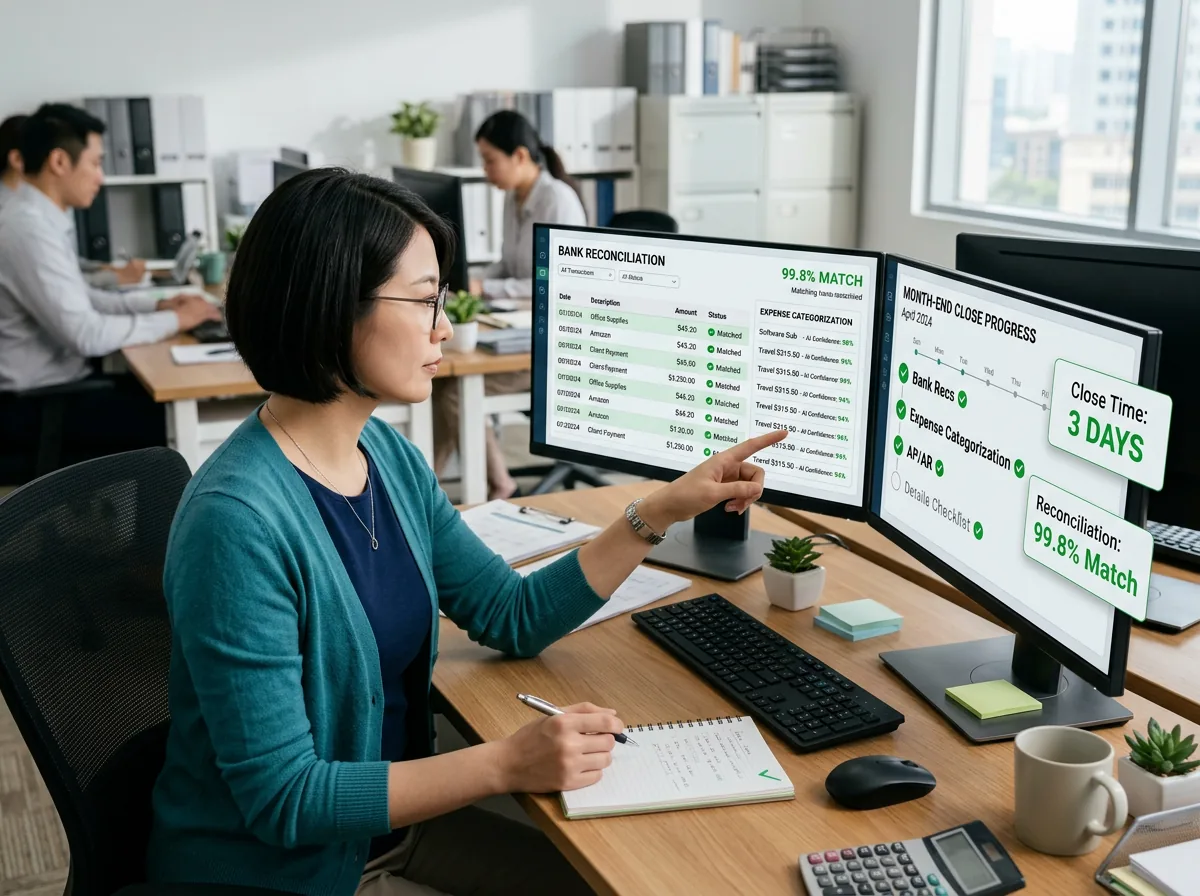
Month-end close shouldn’t take your team two weeks of late nights. Our accounting automation workflows handle bank reconciliation, expense categorization, journal entries, intercompany eliminations, and financial report generation - cutting close time in half and eliminating the manual errors that cause restatements.






Accounting Automation
Close the books in days, not weeks
Accounting teams spend the majority of their time on repetitive, rule-based tasks: downloading bank statements, matching transactions to invoices, categorizing expenses, creating journal entries, reconciling intercompany balances, and compiling financial reports. These tasks follow predictable patterns and business rules - which makes them ideal automation candidates. Our accounting automation pipelines handle the high-volume, low-judgment work that consumes your team’s time: automated bank feeds that download and match transactions daily instead of monthly, AI-powered expense categorization that applies GL codes based on vendor, amount, and description patterns, rule-based journal entry creation for recurring transactions like depreciation, accruals, and prepaid amortization, intercompany elimination workflows that reconcile and eliminate cross-entity transactions automatically, and financial report generation that compiles P&L, balance sheet, and cash flow statements from your GL data. Your accountants focus on analysis, advisory, and exception handling - not data entry and reconciliation.
Why Automate Accounting
What changes when accounting runs on autopilot

50% Faster Month-End Close
Automated reconciliation and report generation compress the close process from 10-15 business days to 5-7. Continuous close practices can reduce this further to 2-3 days for routine months.

Automated Bank Reconciliation
Bank transactions are downloaded daily and matched against your GL automatically. Exact matches are cleared instantly. Fuzzy matches (amount matches with date differences) are suggested for review. Unmatched items are flagged for investigation.

AI Expense Categorization
Expenses are automatically coded to the correct GL account based on vendor name, transaction amount, description keywords, and historical patterns. New vendors are suggested based on similar existing categorizations.
Recurring Journal Entries
Depreciation, amortization, accruals, prepaid expense allocation, and other recurring entries are generated and posted automatically each period. Schedules are maintained and adjusted without manual calculation.

Intercompany Automation
Cross-entity transactions are identified, matched, and eliminated automatically. Intercompany balance reconciliation runs continuously instead of once per close cycle, catching discrepancies in real time.

Audit-Ready Documentation
Every automated transaction includes a complete audit trail: source data, matching logic, categorization rule applied, and approval record. Reconciliation workpapers are generated automatically for auditor review.
How It Works
From manual close to automated accounting
Assess
We map your current close process, identify bottlenecks, and prioritize automation opportunities by time savings and error reduction potential.
Connect
Bank feeds, ERP systems, expense platforms, and intercompany ledgers are connected to our automation layer. Data flows are established and validated.
Automate
Reconciliation rules, categorization models, journal entry templates, and report formats are configured and tested with your historical data before going live.
Optimize
Monthly reviews track close time, error rates, and manual intervention frequency. Categorization models improve over time. New automation opportunities are implemented in each cycle.