Any format · Any platform · 99.5% accuracy

Catalog Processing Services

Your product catalog needs organizing, standardizing, and importing into your ecommerce platform - but the data sits in PDFs, print catalogs, supplier spreadsheets, and legacy systems that don’t talk to each other. Acelerar’s catalog processing team transforms raw product data from any source into structured, platform-ready listings.
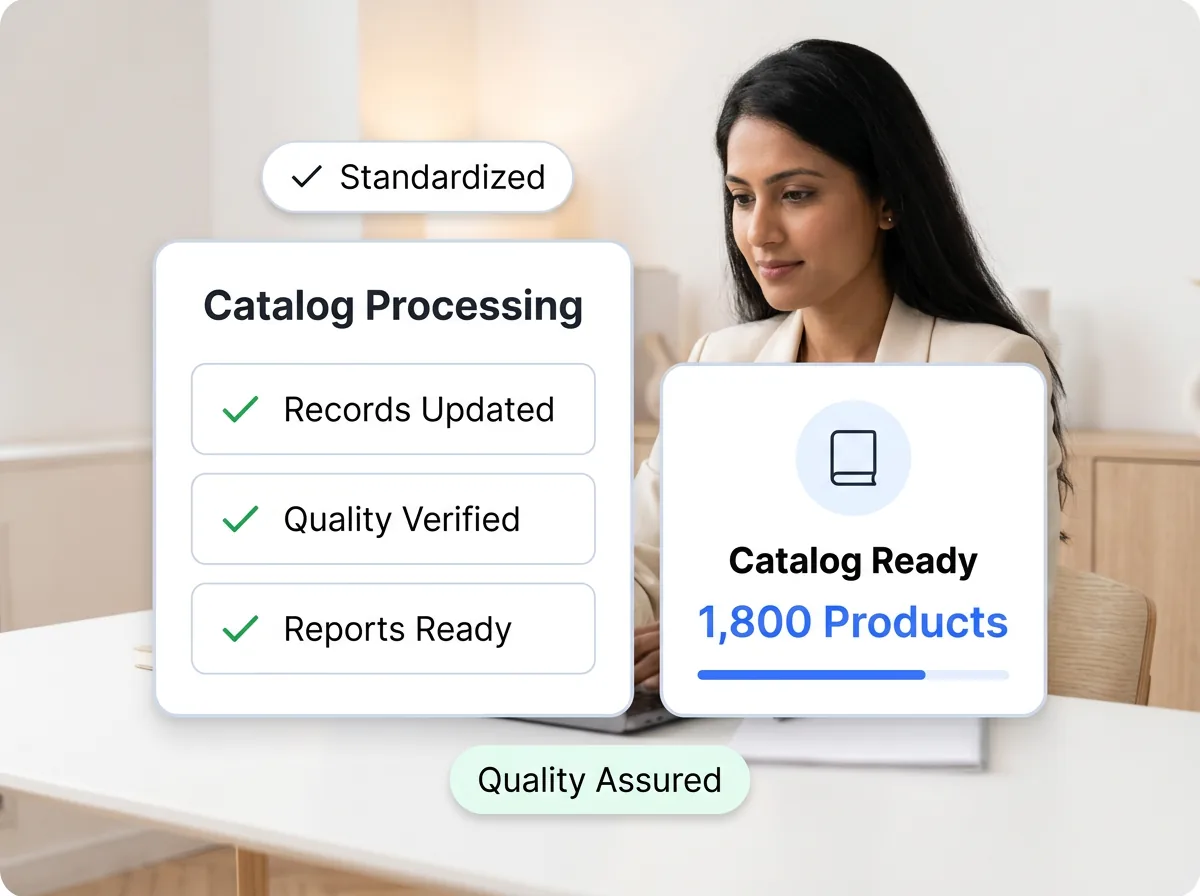

Catalog processing workflow showing print catalogs and spreadsheets being transformed into structured ecommerce product listings
500+
Teams Deployed
99.5%
Accuracy SLA
70%
Avg Cost Savings
7-Day
Team Deployment
4.9 out of 5·from 120+ verified reviews
Clutch (4.9)Google (4.8)GoodFirms (5)

What is catalog processing?

Catalog processing is the work of converting raw product information from any source - print catalogs, supplier PDFs, manufacturer spreadsheets, legacy databases, or even competitor websites - into structured, standardized product data ready for your ecommerce platform. This involves extracting product details (titles, descriptions, specifications, pricing, images), organizing them into consistent categories and attribute schemas, validating accuracy against source materials, and formatting everything for import into Shopify, Magento, Amazon, or whatever platform you sell on. For businesses adding product lines from new suppliers or migrating from manual processes, catalog processing eliminates the bottleneck between sourcing products and selling them.

The e-commerce outsourcing market

E-commerce operations outsourcing is growing as online retail scales globally.

$854.6B
Global BPO market size in 2025
Grand View Research, 2024
83%
Of executives leverage AI in outsourced services
Deloitte, 2024
$87K
Average per-employee savings from outsourcing
IAOP, 2023

In-house catalog processor vs. Acelerar

In-House (US)

$42K/yr

per year / per person

Salary, benefits, training, and equipment for one full-time US-based catalog processing specialist with OCR and data extraction skills

With Acelerar

$13K/yr

per year / per person

Fully loaded rate includes salary, infrastructure, AI-assisted extraction tools, QA, and dedicated account manager for catalog processing

Why businesses choose Acelerar for catalog processing

Any Source Format Accepted

Print catalogs, scanned PDFs, Excel spreadsheets, XML feeds, legacy database exports, Word documents, or even product photos with text. We extract and structure product data from whatever source material you have available.

Platform-Ready Output

Processed catalog data is formatted specifically for your target platform: Shopify CSV, Magento import templates, Amazon flat files, WooCommerce product feeds, or any custom format. Upload-ready from the moment we deliver.

Standardized Taxonomy

We build consistent category hierarchies, attribute schemas, and naming conventions for your entire catalog. When one supplier calls it “stainless steel” and another says “SS304,” we normalize to your preferred standard.

OCR & Data Extraction

Print catalogs and scanned documents are processed using OCR technology with manual verification. We extract product specifications from tables, pull pricing from formatted layouts, and capture image associations accurately.

Scalable Volume Processing

From a 50-page supplier catalog to a 10,000-product database export, our workflows handle any volume. Team capacity scales within 48 hours for large catalog builds without quality compromise.

99.5% Accuracy SLA

Every processed record goes through automated validation and manual QA review. Pricing, SKUs, specifications, and image associations are verified against source material before delivery.

From raw catalogs to platform-ready data in 4 steps

1

Receive

Send your source catalogs in any format: PDFs, print scans, spreadsheets, XML feeds, or database exports. We assess the data and define the processing scope.

2

Extract

Our team extracts product data from source materials: titles, descriptions, specifications, pricing, categories, images, and any other relevant attributes.

3

Standardize

Extracted data is organized into your target taxonomy, attributes are normalized, categories are mapped, and the output is formatted for your ecommerce platform.

4

Deliver

Platform-ready catalog files are delivered for import, or we upload directly into your ecommerce system. A quality report accompanies every delivery.

We work with your e-commerce platforms

Our teams are trained on the platforms you already use.

What our e-commerce clients say

Acelerar handled our entire catalog migration (50,000+ SKUs) without a single missed deadline.

The Acelerar team is a self-sustaining machine. They’ve become an extension of our own team.

We needed reliable, fast data entry at scale. Acelerar delivered consistent quality from day one, no ramp-up time needed.

Where e-commerce outsourcing is heading

E-commerce operations are increasingly handled by specialized outsourcing teams with AI capabilities.

2025
$854.6B
Global BPO market size
Grand View Research, 2024
2030
$1.22T
Projected global BPO market at 8.6% CAGR
Grand View Research, 2024
2030
66%
Of tasks still need human skills or human+AI combo
McKinsey, 2023
ISO 27001 Certified
ISO 9001:2015
NDA for Every Team Member
Encrypted Data Transfer

Catalog Processing FAQs

Catalog processing is the service of converting raw product information from various source formats into structured, organized product data suitable for ecommerce platforms. It encompasses data extraction from print and digital catalogs, attribute standardization, category mapping, image association, and formatting for platform-specific import. The goal is to bridge the gap between how suppliers provide product data and how your ecommerce platform needs it structured.
We process catalogs from virtually any source: printed catalogs (scanned), PDF product sheets, supplier Excel spreadsheets, XML product feeds, CSV exports from legacy systems, manufacturer websites, Word documents with product tables, and even photographed catalog pages. If product information exists in a readable format, we can extract and structure it for your ecommerce platform.
Yes. Print catalog digitization is one of our core services. We scan physical catalogs, apply OCR to extract text, manually verify the extracted data against the original, structure the information into product records with proper attributes, and format everything for upload to your ecommerce platform. Images from print catalogs are captured, enhanced, and associated with the correct products.
We create a master data taxonomy that defines standard category hierarchies, attribute naming conventions, value formats, and measurement units. All incoming catalog data is mapped to this taxonomy during processing. When different suppliers use different terminology for the same attribute, we normalize everything to your preferred standard so your catalog maintains consistency regardless of the data source.
Turnaround depends on catalog size, source format complexity, and attribute depth. Small catalogs (100-500 products from clean spreadsheets) take 3-5 business days. Mid-size projects (1,000-5,000 products) take 1-3 weeks. Large catalog builds from print or PDF sources (10,000+ products) are scoped with custom timelines. We provide a specific estimate after reviewing your source materials.
Pricing varies by source format and complexity. Processing from clean digital sources (spreadsheets, XML) costs $1-$3 per product. PDF and print catalog processing with OCR costs $3-$7 per product due to the extraction work involved. Large catalog projects receive volume pricing. Monthly processing retainers for ongoing supplier catalog updates start at $1,200. Contact us with sample source materials for an accurate quote.
Yes. We process catalogs in English, Spanish, French, German, Portuguese, and other major languages. For multi-language ecommerce stores, we structure product data with language-specific fields for titles, descriptions, and attributes. If translation is needed, we coordinate with professional translation services to ensure accurate product terminology in each target language.
Yes. We process catalogs for both B2B and B2C ecommerce businesses. B2B catalogs often have additional complexity: tiered pricing, minimum order quantities, customer-group-specific pricing, technical specifications, and compliance documentation. B2C catalogs focus more on consumer-facing descriptions, lifestyle attributes, and marketing copy. Our team handles both with tailored workflows.
We use a three-layer accuracy process: automated validation rules check for missing fields, format errors, and logical inconsistencies. Manual verification compares processed records against source materials for pricing, SKUs, and specifications. QA review samples a statistically significant percentage of records for final validation. Our accuracy SLA is 99.5% across all catalog processing projects.
Yes. If your source catalog is missing attributes like weight, dimensions, material composition, or product descriptions, we research and fill those gaps using manufacturer websites, spec sheets, and industry databases. Data enrichment ensures your product listings have the complete information shoppers need to make purchase decisions and that search filters work correctly on your store.

Got catalogs that need processing?

Send us a sample, and we’ll deliver a scope estimate and quote within 48 hours.

No commitment required. We respond within 24 hours.