
$7/hour · 7-day deployment · 99.5% accuracy SLA
Lightspeed to Shopify Migration Outsourcing
Moving off Lightspeed is not just an online-store migration. If you run Lightspeed Retail, your point of sale, inventory counts, and in-store sales history all have to land in Shopify in sync with your products. We run that whole move for you so the store, the stockroom, and the POS all agree on day one.
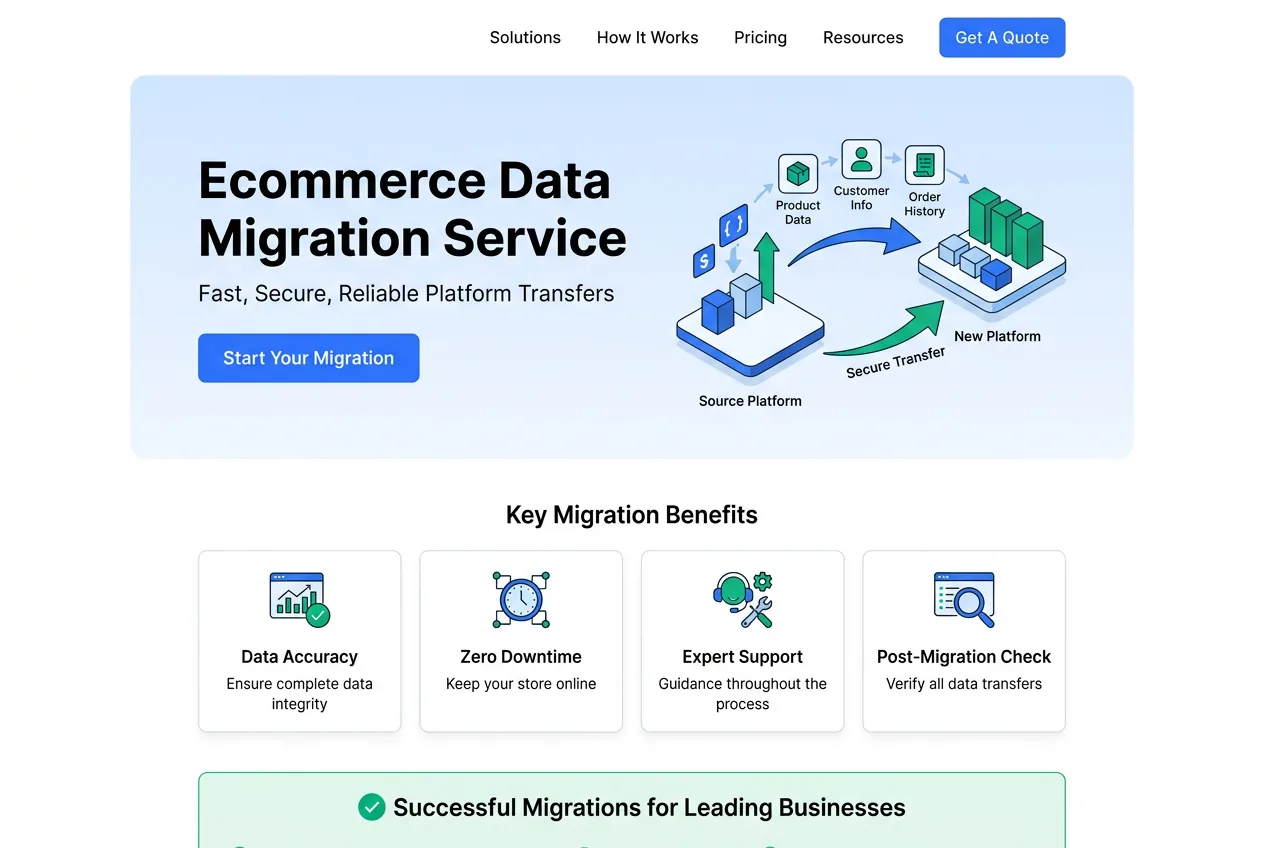


Lightspeed to Shopify Migration
Why Lightspeed migrations need manual work, not just a tool
This page is part of our ecommerce data migration services. Automated migration apps move rows from one database to another. They do not clean up your catalog or protect your stock counts. Lightspeed is the system of record for your inventory, and getting those counts right in Shopify is the part that goes wrong most often on a DIY move. Retailers leaving Lightspeed often carry hundreds of SKUs with thin product data, so the move is also the moment to collapse duplicate SKUs, write the descriptions and specs that were never filled in, and rename images so the store looks finished on launch day. That is manual work a dedicated team is built to protect. Every migration ships with a $7/hour starting rate, a 7-day deployment window, a 99.5% accuracy SLA, and ISO 27001 plus ISO 9001:2015 certified controls. No setup fees, month-to-month.
Why Outsource This Migration
Three reasons retailers hand this migration to us

One team owns products, inventory, and POS together
Product catalog, variants, inventory counts, customers, and sales history migrate under one team on one invoice, so your online store and your Shopify POS start from the same numbers.

Your Lightspeed store keeps selling during cutover
We build and validate the Shopify store in parallel while Lightspeed stays live. You go live on your schedule, not during a blackout, and downtime is minutes not days.

A 99.5% accuracy SLA in writing
Inventory counts and product data are reconciled between Lightspeed and Shopify before go-live. If the numbers do not match, we fix them first.
Compare Your Options
DIY app vs freelancer vs Acelerar
| Migration app (DIY) | Freelancer | Acelerar | |
|---|---|---|---|
| Inventory reconciliation | You do it | Rarely | Record-by-record, SLA-backed |
| POS setup on Shopify | Not included | Sometimes | Configured for how you sell |
| 301 redirect mapping | Not included | Sometimes | Every URL mapped |
| Downtime risk | You manage cutover | You manage cutover | Staged, minutes not days |
| Accuracy guarantee | None | None | 99.5% SLA in writing |
| Pricing | Per-record app fee | Flat, opaque | $7/hour, month-to-month |
| Security | Your responsibility | Unknown | ISO 27001, ISO 9001 |
How It Works
The Lightspeed to Shopify migration process
Audit and export
We audit your Lightspeed setup: product count, variant and matrix complexity, inventory volume, customer and sales history, and whether you run Retail POS, eCom, or both. Then we export products, inventory, and customers.
Field mapping
Every Lightspeed field is mapped to its Shopify destination. Matrix products become Shopify variants, inventory maps to the correct Shopify locations, and register data is translated into a Shopify POS configuration.
Staging build
We import products, inventory, customers, and sales history into a Shopify store while Lightspeed stays live and selling. Images are re-hosted and collections rebuilt. Nothing is public yet.
Redirect mapping
If you run Lightspeed eCom, we build the 301 redirect map from every indexed URL to its Shopify equivalent so search traffic follows the move.
Dry run and reconciliation
We run a dry-run import and check inventory counts, product totals, and customer records against Lightspeed record by record. Mismatches are fixed here, before launch.
Cutover and go-live
You switch your domain and POS to Shopify on your schedule. Because the store was built in parallel, downtime is minutes, not days. We monitor Google Search Console after launch to confirm redirects are picked up.
See how your stock counts land before you commit
Worried the migration will scramble your stock counts? Start with a paid pilot on a sample of your Lightspeed catalog and see exactly how products and inventory land in Shopify before you commit the full store.
Get a Custom QuoteTrusted by teams that do not tolerate errors
“Acelerar handled our entire catalog migration (50,000+ SKUs) without a single missed deadline.”
“The Acelerar team is a self-sustaining machine. They've become an extension of our own team.”
“We needed reliable, fast data entry at scale. Acelerar delivered consistent quality from day one, no ramp-up time needed.”