
Database Migration Services With Conditional Zero-Downtime Cutovers
Move a database with the compatibility checks, schema work, full-load controls, replication planning and reconciliation needed for a defensible cutover. Compatibility is measurable. Zero-downtime execution is considered only after the source, target, application and change-capture path pass discovery.
 ISO 27001
 ISO 9001:2015
 GDPR Ready
A controlled migration starts with compatibility and acceptance evidence


Common Challenges
Choose the database migration path before choosing the tool
Engine compatibility and downtime tolerance determine the schema effort, validation plan and rollback design. Tool choice follows.
Same-engine migration with ongoing source changes
An online path can keep the source available while an initial load and supported change replication bring the target closer to current state. It still needs lag monitoring, application readiness and a rehearsed switch.
- ✓Confirm versions and supported replication path
- ✓Baseline full-load counts and replication lag
- ✓Pause or control writes during the final switch if required
- ✓Keep a tested rollback point until acceptance
What's Included
What our database migration service covers
The exact work split is approved after discovery. Database, cloud, application and business-data owners remain visible throughout the project.

Discovery and inventory
Source and target versions, size, growth, extensions, dependencies, security needs and downtime tolerance.

Compatibility assessment
Migration route, unsupported objects, connectivity, data types, database code and application dependencies.

Schema conversion
Tables, keys, indexes and approved database objects mapped to the target design where the route requires change.

Load and replication planning
Full-load sequence, supported change data capture or replication, monitoring and final-delta handling.

Rehearsal and reconciliation
Timed test runs, defect tracking, row and object counts, control totals and application acceptance checks.

Cutover and rollback runbook
Go or no-go criteria, command sequence, owners, evidence, stop conditions and the last safe rollback point.
Route selection
Compare database migration routes before planning cutover
| Route | Downtime | Schema work | Validation focus | Rollback requirement |
|---|---|---|---|---|
| Homogeneous online | Low when replication is supported | Usually limited | Load counts, lag and application switch | Source retained through acceptance |
| Homogeneous offline | Planned outage | Usually limited | Backup, restore and critical-table checks | Tested restore or source reopening |
| Heterogeneous online | Low only after compatibility proof | High | Converted objects, live changes and application behavior | Reversible switch with protected source |
| Heterogeneous offline | Planned outage | High | Converted schema, full-load timing and business totals | Restart and restore sequence |
Database cutover design
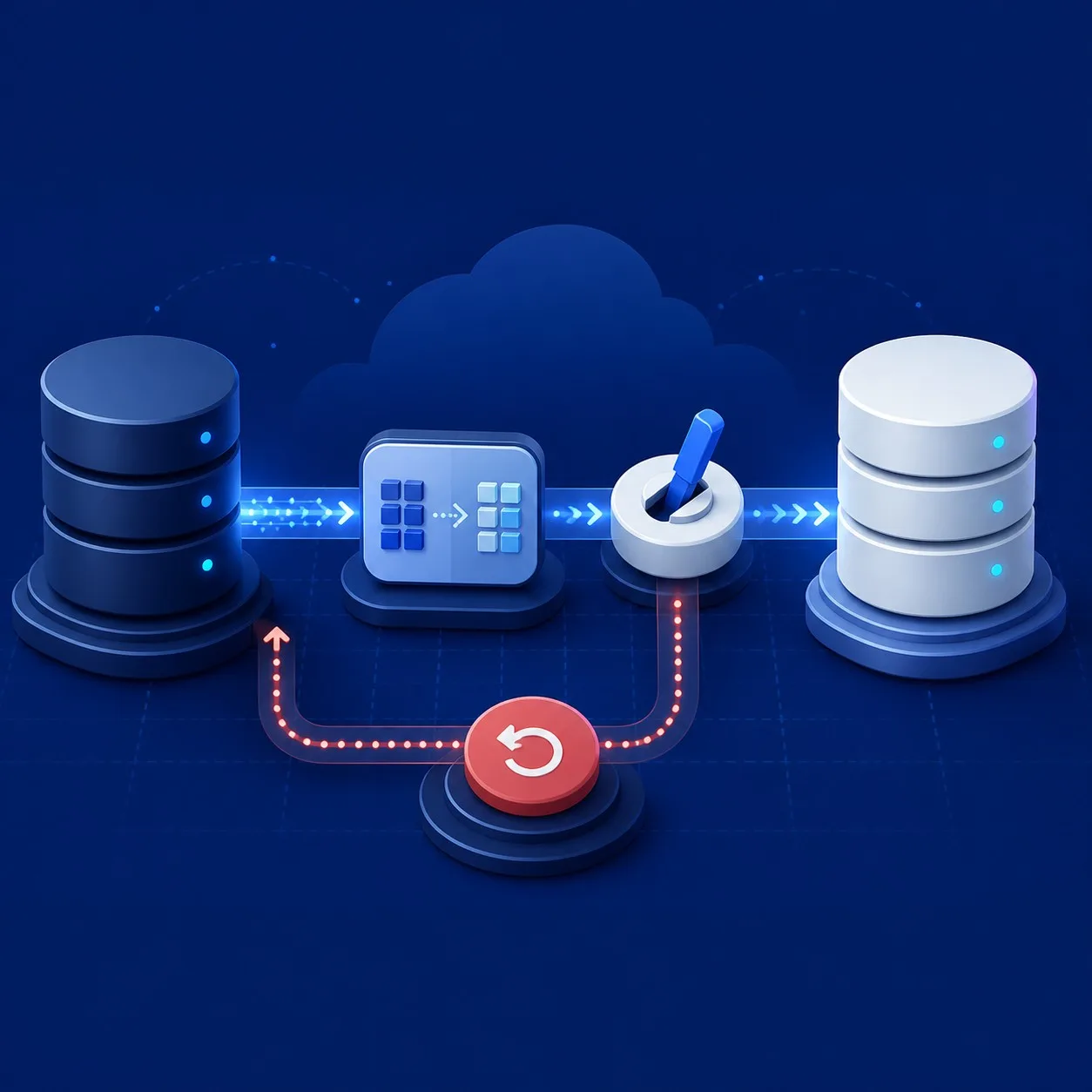
Compatibility decides whether zero downtime is realistic
Engine versions, schema differences, application dependencies and change replication must pass discovery before the team approves an online route.
Related Services
Connect database work to the wider data move
Database migration is one technical route. These services cover broader system, legacy and format-change needs.
Data migration services
Coordinate profiling, mapping, cleansing, test loads, acceptance and system-level cutover support.
Legacy data migration services
Resolve undocumented structures, archival choices, dependencies and decommissioning risk in older systems.
Data conversion services
Change files, values or schemas into an approved target format with documented validation.
Why Acelerar
The controls that decide whether the target is ready
A completed transfer is only one signal. Acceptance requires technical and business evidence.
Compatibility is documented, not assumed
The team records unsupported objects, type changes, permissions, connectivity and application dependencies before timing a realistic test.
Review compatibility →Reconciliation rules are approved
Critical tables, row counts, keys, control totals and business queries have named owners and acceptance thresholds.
Define acceptance →Rollback remains possible
The runbook states stop conditions, decision authority, the last safe reversal point and how the source remains protected until sign-off.
Plan rollback →Database Migration Process
Database migration from discovery to reconciliation
Discover the environment
Inventory engines, versions, objects, size, growth, workloads, dependencies, access controls and outage constraints.
Design the route
Choose homogeneous or heterogeneous and online or offline based on compatibility, risk and business tolerance.
Convert and rehearse
Prepare required schema changes, run a realistic load, test replication where applicable and log defects.
Approve cutover and rollback
Set go or no-go checks, final-change handling, application switch steps, owners and stop conditions.
Cut over and reconcile
Execute the approved sequence, validate technical and business evidence, record exceptions and retain rollback until sign-off.
What clients say about Acelerar delivery
“We needed reliable, fast data entry at scale. Acelerar delivered consistent quality from day one, no ramp-up time needed.”
Database migration services: common questions
Bring us the source, target and downtime tolerance
Share versions, approximate size, write pattern, database objects, application dependencies, security needs and deadline. We will scope the compatibility review, rehearsal and acceptance plan.
- Response within 24 hours — no automated replies
- Custom proposal, not a generic pricing sheet
- $7/hr starting rate, no long-term contracts
- ISO 27001 certified — your data stays yours
Tell us about your project
Fill in the details below and we'll get back to you within 24 hours with a custom proposal.