
Legacy Data Migration Services for Controlled Modernization
Move usable records out of an aging system without carrying every obsolete field, duplicate or undocumented rule into the new environment. We help inventory, profile, map, clean, test, reconcile and document the move before the old system is retired.
 ISO 27001
 ISO 9001:2015
 GDPR Ready
Legacy migration decisions need owners, evidence and a reversible plan


Common Challenges
The legacy migration risks to resolve before cutover
Each risk needs a prevention control, test evidence and a response if the evidence fails.
Undocumented fields and hidden dependencies
Old systems often contain columns, codes, files and scheduled processes whose purpose lives with one employee rather than in current documentation.
- ✓Interview business and technical owners
- ✓Inventory tables, files, reports and integrations
- ✓Classify unknown fields before mapping
- ✓Keep unresolved dependencies in the risk register
What's Included
What legacy data migration services include
The scope starts with what must remain usable in the destination, not with copying everything the old system happens to contain.

Legacy inventory
Systems, databases, files, reports, integrations, owners, access limits and undocumented dependencies.

Archive and retention decisions
Active, historical, duplicate, obsolete and regulated records assigned a documented destination or exclusion rule.

Profiling and discovery
Counts, nulls, duplicates, invalid codes, orphaned records, date ranges and unexpected field usage.

Mapping and cleansing
Source-to-target rules, translations, defaults, approved corrections and visible exception queues.

Test waves and restart controls
Representative batches, checkpoints, rerun behavior, defect logs and acceptance results.

Reconciliation and audit trail
Counts, relationships, control totals, exclusions, unresolved exceptions, approvals and decommissioning evidence.
Legacy risk controls
Turn undocumented legacy risks into testable controls
| Risk | Likely cause | Control | Test | Rollback or retention |
|---|---|---|---|---|
| Missing records | Hidden tables or exports | Complete source inventory | Counts by object and period | Retain protected source copy |
| Changed meaning | Undocumented codes or fields | Approved mapping decisions | Business-owner sample review | Preserve original values in audit file |
| Broken relationships | Weak or reused identifiers | Key and dependency rules | Parent-child integrity checks | Quarantine unresolved records |
| Early decommissioning | Acceptance based only on load completion | Formal sign-off criteria | Workflow and reconciliation review | Keep legacy access until approval |
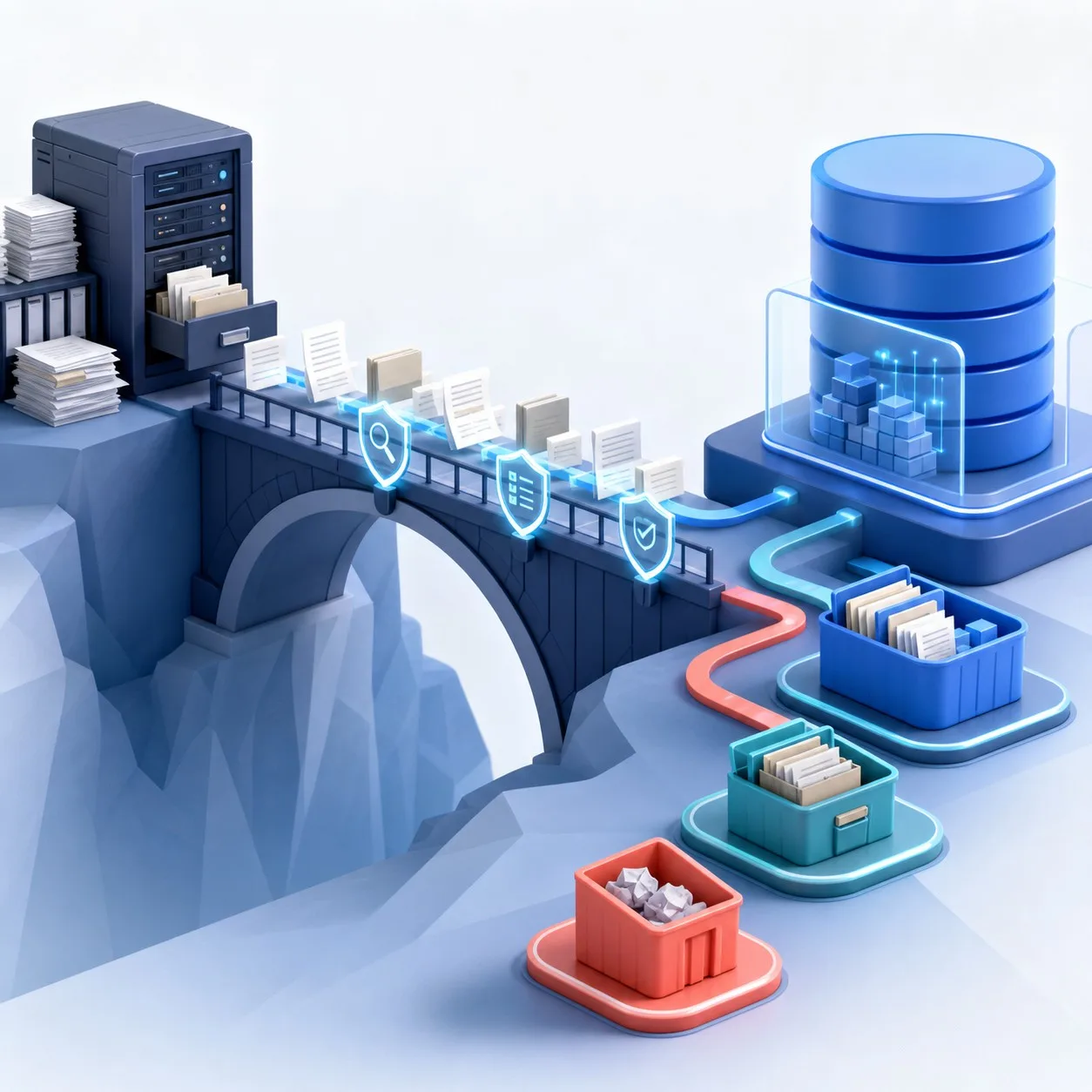
Legacy migration path
Preserve evidence while replacing the old system
The migration connects source discovery, archival decisions, mapping, test waves and decommission approval so undocumented records are not silently lost.
Related Services
Separate modernization from the data work inside it
The right adjacent service depends on whether the main problem is a database route, a wider system move or a format change.
Database migration services
Assess compatibility, schema conversion, replication, rehearsal, cutover and rollback for database moves.
Data migration services
Coordinate preparation, mapping, cleansing, test loads, reconciliation and system handoff.
Data conversion services
Change legacy exports into the format or structure required by a supported destination.
Why Acelerar
Decide what to move, archive and retire
Legacy system modernization is not automatically a lift-and-shift project.
Move records needed in active workflows
Map data that the new system needs for current operations, reporting, customer history or required integrations, then define acceptance checks.
Define active scope →Retain history without forcing it into the target
Keep records that must remain searchable or auditable but do not belong in current workflows, subject to approved retention and access rules.
Plan archival scope →Exclude obsolete data with written approval
Duplicates, expired working files and unused fields are excluded only when the correct business and governance owners approve the rule.
Document exclusions →Legacy Migration Process
Legacy system data migration from inventory to retirement
Inventory and interview
List systems, records, reports, integrations and owners, then capture undocumented business rules while source knowledge is available.
Classify and profile
Decide what may be migrated, archived or excluded, then measure quality and flag unknown values and relationships.
Map and prepare
Approve target mappings, transformations, cleansing rules, retention controls and exception ownership.
Run test waves
Load representative records, test restart behavior, reconcile results and repeat until acceptance conditions are met.
Cut over and decommission
Execute the approved runbook, validate the target, preserve the audit trail and retire the source only after sign-off.
What clients say about Acelerar delivery
“We needed reliable, fast data entry at scale. Acelerar delivered consistent quality from day one, no ramp-up time needed.”
Legacy data migration: common questions
Show us what is known and unknown about the legacy system
Share the system type and age, export access, sample records, available documentation, target, dependencies, retention needs, deadline and downtime tolerance. We will scope the discovery and test plan.
- Response within 24 hours — no automated replies
- Custom proposal, not a generic pricing sheet
- $7/hr starting rate, no long-term contracts
- ISO 27001 certified — your data stays yours
Tell us about your project
Fill in the details below and we'll get back to you within 24 hours with a custom proposal.