
Ecommerce Data Migration Services for Products, Customers and Orders
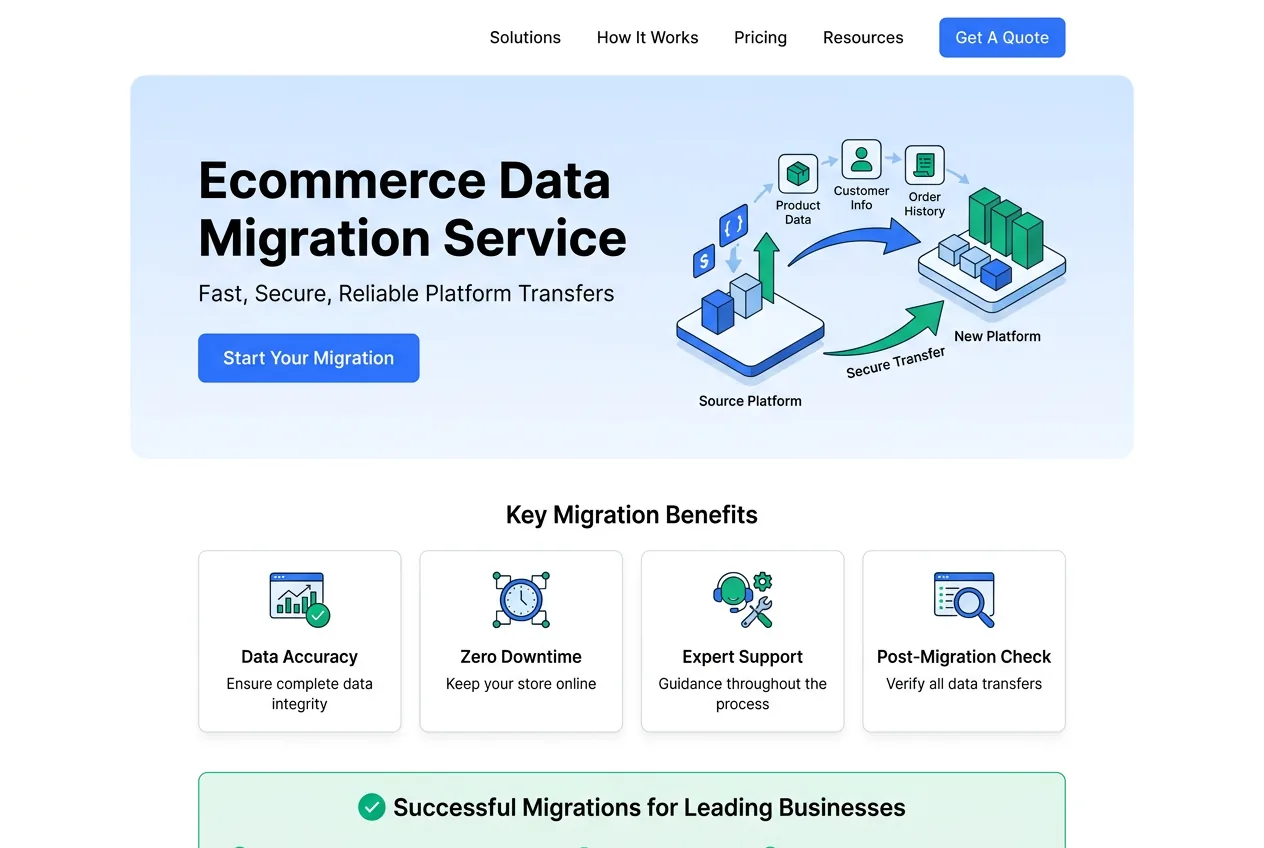
Move connected store records between Shopify, Magento, Adobe Commerce, BigCommerce, WooCommerce and approved platforms. Relationships stay connected. We prepare mappings, clean data, support test loads and reconcile the result while ownership for development, SEO and launch stays explicit.
 ISO 27001
 ISO 9001:2015
 GDPR Ready
Trusted for ecommerce catalog operations and controlled data handoffs


Common Challenges
Why an ecommerce export is not a complete migration
Products connect to variants, media, categories, customers, orders, URLs and apps. Ownership stays explicit. Each relationship needs an acceptance check.
Product models do not map one to one between platforms
Configurable products, options, custom attributes and category rules need deliberate target mappings.
- ✓Map products, variants and options
- ✓Translate attributes and category trees
- ✓Preserve SKU and parent-child relationships
- ✓Assign unsupported values to an exception owner
Client Results
Ecommerce operations built around connected records
Use platform and client evidence only where the route and result are confirmed.
Connected product data handled across 50,000+ SKUs
50,000+ SKUs supported
Products, variants and categories checked together
Thousands of product records managed for National Workwear
Thousands of Shopify SKUs
Ongoing catalog operations
What's Included
What ecommerce data migration services include
The data work is scoped separately from storefront development, design, apps, SEO, analytics and production launch.

Products and variants
SKUs, titles, descriptions, options, attributes, prices, inventory fields and relationships.

Customers and orders
Profiles, addresses, order history, statuses and platform-supported account fields.

Categories and media
Collections, category trees, image references, files and approved source-to-target associations.

Mapping and test loads
Field rules, value translations, sample batches, defects, corrections and repeatable imports.

Reconciliation
Object counts, required fields, relationships, rejected records and business control totals.

SEO and launch handoffs
Data inputs for redirects, metadata, analytics and cutover with each implementation owner named.
Store-object controls
Validate every connected ecommerce object
| Object | Main risk | Mapping requirement | Validation | SEO dependency |
|---|---|---|---|---|
| Products and variants | Lost options or relationships | SKUs, attributes, prices and parent-child rules | Counts, required fields and storefront samples | Product URLs, canonicals and metadata |
| Categories or collections | Changed hierarchy | Source taxonomy to target navigation | Assignment counts and browse tests | Category URLs and internal links |
| Customers and orders | Unsupported history or credentials | Profiles, addresses, statuses and platform-supported fields | Counts, relationships and business totals | Usually none; privacy and retention apply |
| Media and content | Broken references | Files, image associations and content ownership | File availability and page samples | Image URLs, alt text and indexed content |
Connected store data
Migrate relationships, not isolated spreadsheets
Products, variants, categories, customers, orders, media and URLs need coordinated mappings and separate acceptance checks.
Related Services
Choose the migration route that matches your store
Platform-specific pages cover known source and target differences in more detail.

Magento to Shopify migration
Map configurable products, custom attributes and customer groups into Shopify.
WooCommerce to Shopify migration
Move store records while accounting for WordPress content and permalink dependencies.
Data migration services
Plan business data preparation, mapping, testing, reconciliation and controlled cutover support.
Why Acelerar
A responsibility model for ecommerce replatforming
Acelerar confirms data scope first. Technical and business owners remain visible throughout the move.
Data preparation, mapping and reconciliation
We inventory store objects, prepare approved corrections, maintain field mappings, manage exceptions and produce acceptance evidence.
Define our scope →Storefront, apps, redirects, analytics and launch
These responsibilities are included only when explicitly scoped. Otherwise your approved partners own implementation and Acelerar provides the required data handoffs.
Map responsibilities →Business rules, legal decisions and final acceptance
Your team approves taxonomies, exclusions, password handling, retention requirements, go-live timing and the final store result.
Build the acceptance plan →Ecommerce Migration Process
The ecommerce data migration process
Inventory the store
Count products, variants, customers, orders, categories, media, content, URLs, apps and integrations.
Map and prepare
Document target fields, unsupported objects, cleansing rules, credentials, dependencies and exception owners.
Run a test migration
Load representative records into a test store and verify field, relationship, media and storefront behavior.
Plan the delta and launch
Define changed-data capture, freeze timing, redirect and analytics handoffs, validation order and rollback authority.
Reconcile and monitor
Compare object counts and control totals, resolve accepted exceptions and assign post-launch checks.
What ecommerce clients say about Acelerar
“They have handled thousands of products for us flawlessly.”
Ecommerce data migration services: common questions
Tell us what is moving and who owns launch
Share the source and target platforms, record counts, apps, integrations, deadline and current SEO requirements. We will respond with a responsibility matrix, test approach and delivery scope.
- Response within 24 hours — no automated replies
- Custom proposal, not a generic pricing sheet
- $7/hr starting rate, no long-term contracts
- ISO 27001 certified — your data stays yours
Tell us about your project
Fill in the details below and we'll get back to you within 24 hours with a custom proposal.